Xeriscape for Gulf Villas: A Garden That Thrives on 40 Percent Less Water
A Gulf villa garden designed like a Hampshire lawn loses the argument with the climate every July. Xeriscape done right is more beautiful than the thirsty imported template — and cuts water bills by 40 to 60 percent.
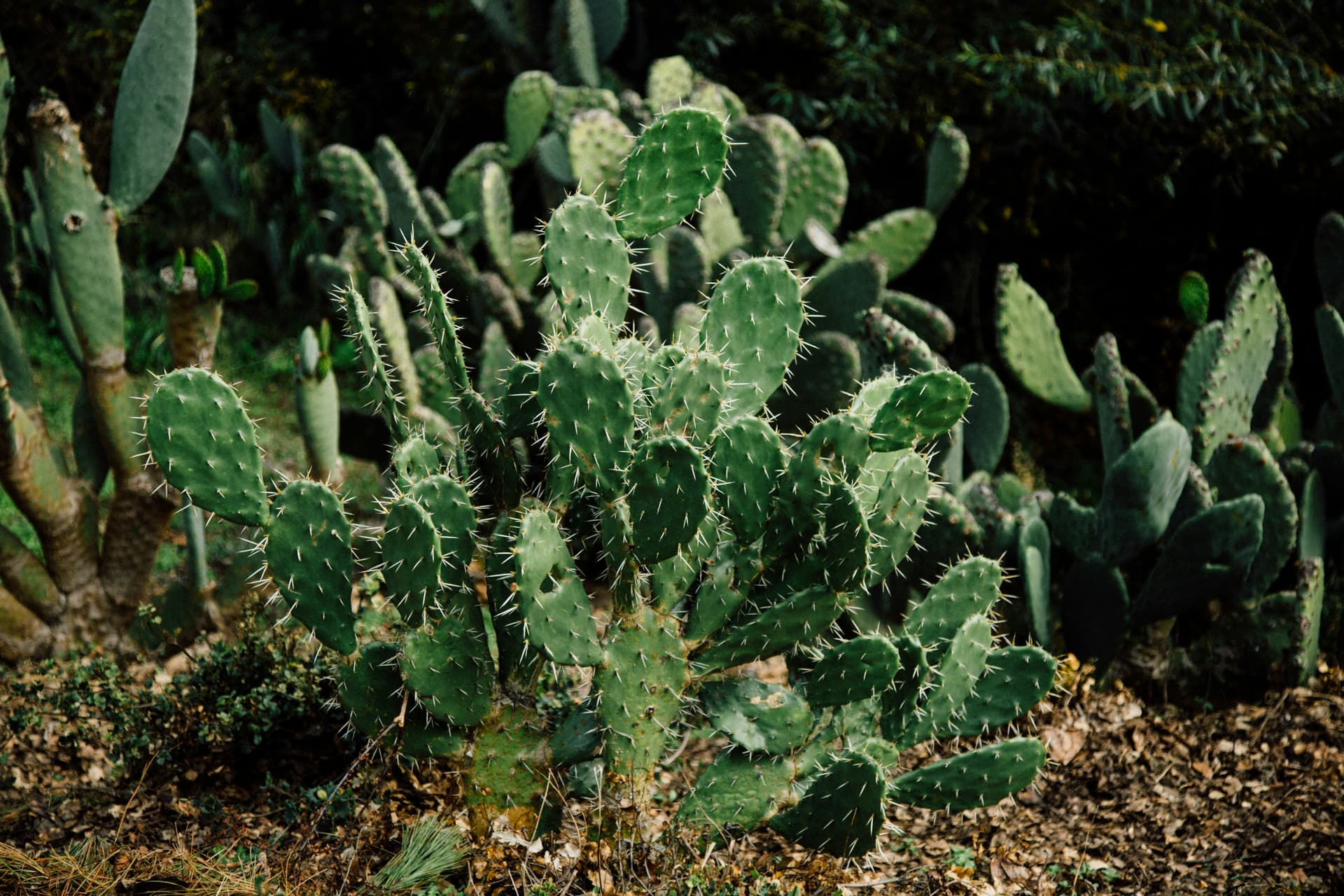
Photo: Unsplash
Having this problem in your own garden?
Get a free site visitA Gulf villa garden designed like a Hampshire lawn will lose that argument with the climate by mid-July. Every summer we are called to rescue estates in Jeddah, Riyadh, and the Abu Dhabi hinterland where the owner spent a fortune on turf, heavy ornamental planting, and imported European style — and three years later the garden is a patchwork of burnt grass, heat-stressed shrubs, and eye-watering water bills that the estate office has stopped arguing with.
There is a different way, and it is not a compromise. A well-designed xeriscape for a Gulf villa is more beautiful than the turf-and-border template it replaces, uses 40 to 60 percent less water, costs less to maintain, and keeps looking right through the months when the imported garden is a disaster.
This is what we specify on estate commissions when the client is ready to hear it.
The principle — design with the climate, not against it
Xeriscape is not rock and cactus. It is not the yellowed gravel of a neglected courtyard. The word literally means "dry landscape" — a landscape designed for dry conditions — and done well, it is a Persian garden, an Andalusian courtyard, a Mediterranean grove. All historical answers to the same problem.
The seven principles we follow on every Gulf xeriscape:
- Plan before planting. Microclimate-mapping (where the peak shade falls, where the shadow lines are at 2 pm in July, where the hot wall reflects) comes before any plant list.
- Improve the soil, once. Gulf sand has no water-retention; we amend the planting zones with organic matter and fine gravel to hold moisture near the root without waterlogging it.
- Hydrozone ruthlessly. Plants with similar water needs group together on their own irrigation zone. Never mix a datilera palm with a petunia bed on the same zone.
- Choose the right plants. 80% regional natives and near-natives, 20% adapted Mediterranean imports.
- Use smart irrigation. Subsurface drip with smart controllers that respond to evapotranspiration data, not a calendar.
- Mineral mulch, not organic. Gravel, decomposed granite, or crushed stone 5 cm deep reflects heat less than bare soil, retains soil moisture, and suppresses weeds for a decade.
- Limit the lawn to where it earns its keep. A small paspalum or Bermuda lawn in a shaded family area is fine. Four thousand square metres of turf on an estate in Riyadh is not.
The plant palette — a Gulf-native working list
This is the core palette we work from on estate projects in Jeddah, Riyadh, Dammam, Dubai, Doha, and Manama. Every plant here will thrive on supplemental water only, once established. None requires daily irrigation, none burns at 48 °C.
Structural trees
- Prosopis cineraria (ghaf) — the national tree of the UAE, tap roots reach 50 m for water, tolerant of salinity, survives on winter rain alone once established. Plant at estate boundaries and along driveways.
- Vachellia tortilis (umbrella thorn / samar) — flat-crowned native acacia, iconic Arabian profile, casts the dappled shade this climate is built for.
- Ziziphus spina-christi (sidr) — heritage fruiting tree, culturally important, produces honey from its flowers, extremely drought-tolerant.
- Phoenix dactylifera (date palm) — the classical centerpiece, fruiting cultivar for traditional gardens or Medjool for ornament and eventual harvest.
- Cordia myxa (mukhait) — small shade tree, beautiful foliage, heritage food fruit.
Mid-height structure
- Moringa peregrina (ben tree) — fast-growing, extraordinary drought tolerance, feathery foliage.
- Dodonaea viscosa (hopbush) — evergreen screen, red seed pods, grows on almost any soil.
- Parkinsonia florida (palo verde) — green-barked small tree, yellow flowers, Arizona-origin, superb in GCC.
- Calligonum comosum (abal) — native, wiry form, red "flowers", reaches 2 m.
Groundcover and colour
- Pennisetum setaceum 'Rubrum'* — ornamental grass, deep burgundy, tolerates full sun and drought.
- Ruellia simplex (Mexican petunia) — violet flowers, self-sufficient in heat.
- Portulacaria afra (elephant bush) — succulent shrub, survives anything.
- Lantana camara — multicoloured bloom through the worst of summer, pollinator-friendly.
- Aptenia cordifolia — succulent groundcover, covers soil fast, pink daisy-like flowers.
Specimen succulents and architectural plants
- Agave americana — century plant, blue-grey rosette, sculptural.
- Agave attenuata — softer, no spines, elegant.
- Yucca rostrata — blue-silver leaves, trunk develops over decades.
- Euphorbia ammak — columnar candelabra, Gulf native, striking as a specimen.
- Aloe vera in mass — practical (medicinal) and beautiful in repetition.
The cultural heritage layer
- Date palm groves in the traditional pattern — 7-8 m spacing, undersown with citrus and bananas in the shaded zone.
- Sidr and neem as shade and shelter trees.
- Pomegranate and fig for the kitchen garden.
- Frankincense (Boswellia sacra) — rare, expensive, but for clients who want a heritage Arabian reference.
◆ NAS Landscape
Not sure if this applies to your garden?
The four causes above look alike from a distance but need different treatments. A 30-minute site visit from our specialist gives you the right answer — no guessing.
Request a free diagnosisThe irrigation system — the single most important engineering decision
A xeriscape without smart irrigation is a dead xeriscape. Gulf estates we work on run on:
- Subsurface drip on every planting bed — emitters at 30 cm spacing, buried 15 cm deep. Water goes straight to the root zone, none lost to evaporation, none wetting foliage.
- Pressure-compensating drip lines — essential on estates with elevation changes, so the emitter at the far end of a long run delivers the same flow as the first.
- A smart controller — Rachio, Hunter Hydrawise, or similar — that ingests local weather data and adjusts run times based on evapotranspiration. Typically we see 30-45% water reduction versus calendar-based watering in year one alone.
- Dedicated zones for palms separate from shrubs separate from ground covers separate from the small lawn.
- Quarterly system inspection — clogged emitters are the silent death of Gulf xeriscapes. Our maintenance contracts include full system tests every three months.
A well-designed system uses 40-50% less water than a conventional Gulf villa garden in year one. By year three, when the native planting is established and the weaning-off protocol has been completed, that rises to 60-70%.
The soil work — done once, matters forever
Gulf estate sand is a problem. Water runs through it like a sieve and nutrients leach out before the plant uses them. But the fix is infrastructure, not ongoing labour.
What we do on a new site:
- Excavate the planting zones to 50 cm depth, backfill with a 60/25/15 blend of screened sand, fine gravel, and composted palm waste. This gives the root zone water retention without waterlogging.
- On low-lying areas, install perforated drainage pipes beneath to handle the rare but heavy rainfall events that now hit the Gulf.
- Cap with 5 cm of mineral mulch — crushed marble, granite, or seasoned gravel in a colour that matches the architecture.
This is a substantial first-year investment and the reason we quote xeriscape projects with proper soil work differently from quick-turn landscape firms. A xeriscape built on unimproved Gulf sand fails at year four. A xeriscape built on engineered substrate lasts forty.
Common mistakes — why some Gulf xeriscapes still fail
Even with the right plant palette, Gulf xeriscapes fail for predictable reasons:
- Too much irrigation after year two — the native plants are weaned to the climate, not a drip line. Continuing to water them aggressively produces soft, disease-prone growth.
- Wrong mulch. Organic mulch (wood chip) decomposes in Gulf heat within months, turns into a heat-absorbing brown blanket, and actively hurts the garden. Mineral only.
- Over-fertilisation. Native plants do not want European-garden feeding. One light spring application of a slow-release, organic-based fertiliser is plenty.
- Ignoring the soil compact zone. Heavy construction equipment compresses Gulf sand into a waterproof layer 40-60 cm down that roots cannot cross. Must be broken up at planting.
- Planting in the wrong season. Gulf planting is an October-February job, never May-September. A new shrub planted in Jeddah in July has about a 10% survival rate.
What the atelier does
Our Gulf practice has delivered xeriscape and heritage garden projects across Jeddah, Riyadh, Dammam, Dubai, Abu Dhabi, Sharjah, Doha, Manama, Kuwait City, and Muscat for three decades. We source the plant material from our own nurseries (for the heritage species a commercial nursery does not stock) and engineer the irrigation and substrate ourselves — we do not subcontract the parts that matter.
For royal estates, resort developments, and private villa commissions, we typically deliver a complete xeriscape design-build — from microclimate survey through irrigation engineering through planting through two years of maintenance supervision until the garden is self-sufficient.
When to call us
Call the atelier when:
- You are building or renovating a villa or estate in the Gulf and want a garden that survives the climate without a six-figure annual water bill
- You inherited a thirsty imported garden that is failing and need a conversion path to xeriscape without ripping everything out in one pass
- You are planning a resort or hotel project in the GCC and want a heritage-Arabian planting plan that also meets modern water-efficiency targets
- You want a proper irrigation system designed and engineered, not a drip line dropped into a landscape by a local contractor
A garden that works with the Gulf climate looks more Gulf than one that fights it. Send a photo of your site and a sense of the scale to WhatsApp +90 535 422 5227 — a real landscape architect will respond the same working day. No charge for the first read.
NAS Landscape has designed and delivered Gulf estate gardens across the GCC since the early 1990s. Written by MHD ZUHIR MADAMANI, Istanbul.
◆ A real diagnosis, not a guess
Send a photo. Get a plan.
Our specialists handle cases like yours across Istanbul and the wider region. Share a photo on WhatsApp or book a free site visit — whichever is faster for you.
60+ years · 7 countries · 500+ projects · third-generation atelier
Editorial & digital direction
Written, designed, and built by MHD ZUHIR MADAMANI · Istanbul