Tree Roots Under Your Villa: When to Worry, When to Act, When to Call Us
A crack in the paving and a mature tree nearby usually triggers panic — and a bad decision. Most 'root damage' is an unrelated failure a curious root exploited. Here is how to tell the difference before you lose a tree.
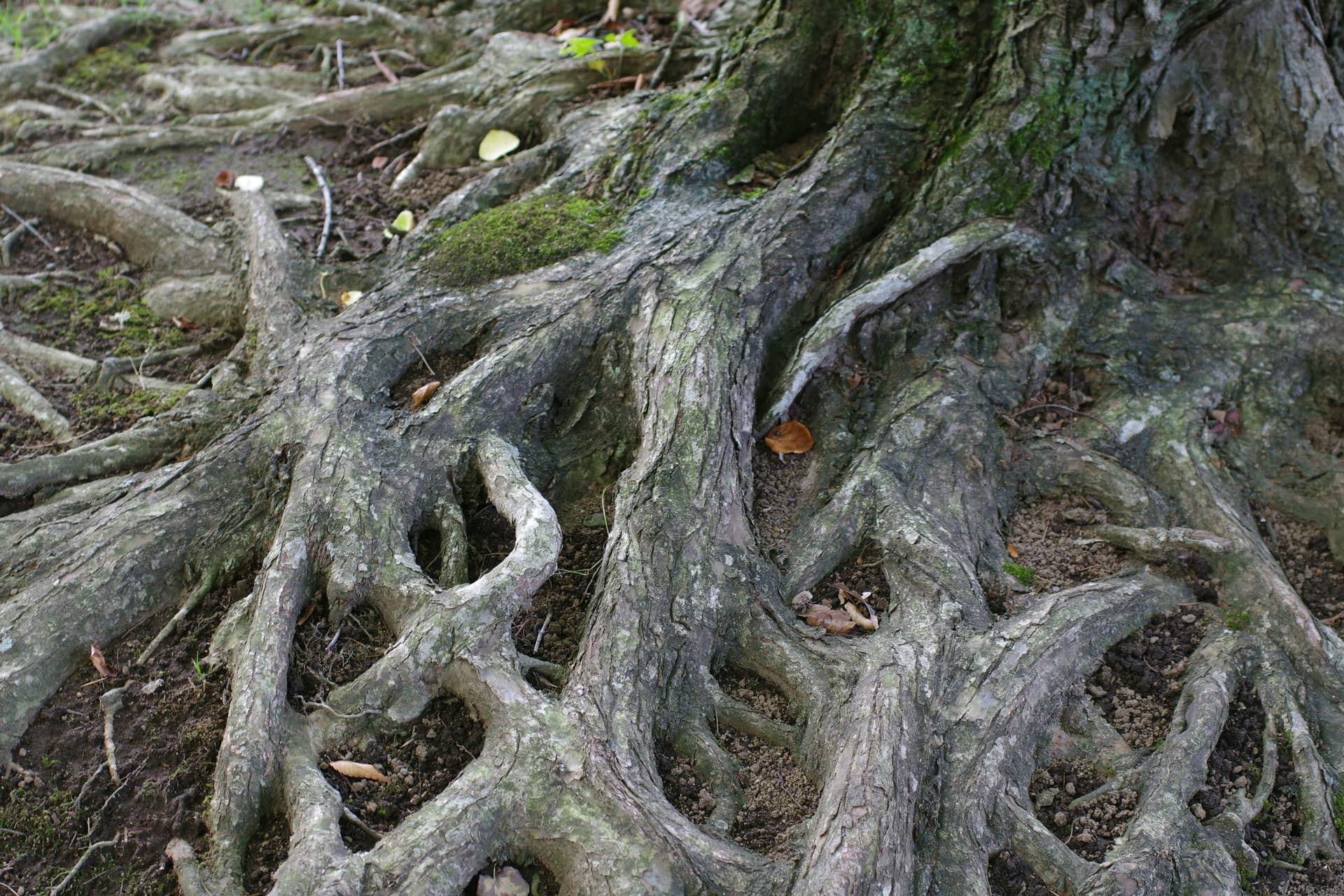
Photo: Unsplash
Having this problem in your own garden?
Get a free site visitNothing in a villa garden triggers a late-night Google search quite like the suspicion that tree roots are under your house. A hairline crack in a terrace paver, a damp patch on a wall, a slow drain that was fine last year — and suddenly every mature tree in the garden feels like a threat. The fear is rarely wrong in principle. Mature trees do cause damage. But what most owners do next — calling for a tree removal, or ripping up paving, or pumping root-killer into the lawn — is usually a worse decision than the original problem.
This field note is about how to separate the real damage from the phantom, what you can do without calling anyone, and when the atelier should actually be on your doorstep.
What tree roots can and cannot do
Start with the physics. Tree roots are soft, slow, and opportunistic. They do not burst through concrete, brick, or sealed clay pipe in pursuit of water or space. They grow into whatever voids and weaknesses already exist — a cracked paver, a joint failure in an old sewer, a gap in a foundation footing, a dry patch of soil under a slab. The damage is therefore a two-stage story: something else fails first, and the tree finds its way in.
What roots actually do:
- Enter cracked or compromised pipes and expand the crack
- Thicken and widen over decades under a paver or path, lifting it slightly
- Dry out clay soil aggressively on one side of a house, causing the foundation to settle unevenly (clay shrinkage subsidence)
- Compete with lawn grass for water on a drip-irrigated villa garden
What roots basically do not do in a well-built villa:
- Break through a sound, unbroken PVC or concrete pipe
- Crack a modern reinforced-concrete raft or pile foundation
- Travel horizontally more than about 1.5 times the tree's canopy radius under normal conditions
- Move through dry, compacted urban soil as quickly as most owners imagine
Most panic in the last ten years about "root damage" turns out, on inspection, to be a separate failure that a curious root then exploited.
How to tell the real warning signs from the harmless
Paving and hardscape
Real warning: A paver is tilted by more than 10 mm, water now pools against a threshold, or a whole section of path is rising visibly each year. An exposed surface root is crossing under a structural slab.
Harmless: A tiny hairline crack in an individual paver. A root visible at the surface in an open planting bed. Leaves and debris collecting at a path edge.
Walls and foundations
Real warning: A diagonal crack stepping across bricks (stair-step cracking) at 45 degrees, wider than 3 mm at the top. A door or window has started sticking in a dry summer and returning to normal after rain. A damp patch on an interior wall immediately behind a mature tree.
Harmless: Vertical hairline cracks in lime render. Settlement cracks that have not changed in five years. Paint flaking on a sunny exterior wall.
Drains and plumbing
Real warning: A recurring slow drain in a bathroom or kitchen that clears temporarily after a plumber and returns within six to twelve months. A rising damp patch in a lawn over the line of the sewer. Flushing or running water produces a wet spot in the garden.
Harmless: A single slow drain that clears with enzyme cleaner and stays cleared. Wet patches directly under gutters.
Pool and pool equipment
Real warning: A saltwater or chlorine pool shows a persistent, unexplained water loss beyond normal evaporation, and the loss is worse on windless days. Pool decking is lifting near a tree.
Harmless: Leaves in the pool. Algae after a hot week.
◆ NAS Landscape
Not sure if this applies to your garden?
The four causes above look alike from a distance but need different treatments. A 30-minute site visit from our specialist gives you the right answer — no guessing.
Request a free diagnosisThe three things to do before calling a tree down
Almost every "we must remove this tree" consultation we see starts with a fixable problem and ends, on proper diagnosis, without removal.
1. CCTV the drain before anything else. If the worry is a blocked or leaking sewer, a plumber's CCTV camera run through the line shows the actual problem — crack, root intrusion, displaced joint — for under the cost of a single tree removal. Eighty percent of "tree root" drain problems are old pipe joints failing from age, and the roots are opportunistic arrivals, not the root cause.
2. Install a root barrier. If a specific tree and a specific structure are in proximity and diagnostic tests show active root activity, a high-density polyethylene (HDPE) root barrier, 60 cm deep, installed between the two, redirects future growth without harming the tree. This is routine work on our Istanbul villa projects when a mature specimen is closer than 4 m to a new terrace.
3. Have the soil under a stressed foundation assessed. If there are subsidence cracks on a wall near a mature tree in clay soil, the answer is almost always either (a) increase irrigation on that side of the house in the summer to keep the clay from shrinking, or (b) install a root barrier, or (c) both. Removing the tree can actually make subsidence worse by rapidly rehydrating the clay, causing heave.
When removal is genuinely the right answer
Some situations do call for the tree to come out, and delaying makes the problem worse:
- A structurally dangerous tree (hollow trunk, major limb failures, fungal brackets) in a high-target area like over a house or driveway
- A species notoriously invasive for the site (poplars, willows, certain elms near drains in urban plots)
- A tree planted so close to a foundation (under 2 m from a wall) that no barrier can be effective
- A tree actively lifting a structural slab in a way that cannot be redirected
In these cases we specify removal, but we also insist on the three-step protocol of remove, grind the stump, install a root barrier before replanting — otherwise the next tree inherits the same problem in five years.
When to call us
The atelier handles root and subsidence investigations across Istanbul and the wider region. Call us when:
- You have a diagonal crack on a wall near a mature tree and a builder has told you to remove it
- A recurring drain problem keeps coming back after plumber visits
- You are buying a villa with mature trees close to the house and want an independent pre-purchase arboricultural assessment
- You are planning a new terrace, pool, or hardscape within 4 m of a mature tree and want the root zone properly respected from day one
Mature trees add value to a villa. Losing one to a misdiagnosis is an expensive mistake. Send a photo of the crack, the tree, and the distance between them to WhatsApp +90 535 422 5227 — a real landscape architect will look at it the same working day. No charge for the first read.
NAS Landscape has assessed, protected, and relocated mature trees across villa and estate projects in Türkiye, the Levant, and the Gulf since 1965. Written by MHD ZUHIR MADAMANI, Istanbul.
◆ A real diagnosis, not a guess
Send a photo. Get a plan.
Our specialists handle cases like yours across Istanbul and the wider region. Share a photo on WhatsApp or book a free site visit — whichever is faster for you.
60+ years · 7 countries · 500+ projects · third-generation atelier
◆ More field notes
 Maintenance
The Monthly Villa Garden Maintenance Checklist (The One Professionals Actually Use)
Twelve months, task-by-task, from the atelier's actual maintenance rotation. If you follow this calendar, your garden gets better every year instead of worse.
 Maintenance
Reviving a Neglected Villa Garden: The Atelier's 90-Day Recovery Plan
You inherited a garden that has been left alone for three, five, ten years. Everything looks dead. It is not — but you have three months to prove it. Here is the atelier's rescue sequence.
Editorial & digital direction
Written, designed, and built by MHD ZUHIR MADAMANI · Istanbul