Preparing a Garden for the First Heatwave: A 4-Week May Checklist
Summer does not kill gardens — a garden entering summer unprepared does. Four weeks of work in May protects the entire season. Here is the week-by-week plan.

Photo: Unsplash
Having this problem in your own garden?
Get a free site visitAlmost every garden emergency we are called to between June and September traces back to the same cause: the garden entered summer unprepared. Irrigation was not tested. Mulch was thin or missing. Sun-sensitive plants had not been shaded. The owner was surprised by the first 35 °C week, by which point plants were already in trouble.
May is the month that decides how your garden survives summer. Four weeks of focused work now protects the entire season. Here is the week-by-week plan we work through on villa commissions across Türkiye, the Turkish coast, and the Gulf.
Week 1: the infrastructure audit
Before any cosmetic work, test the systems.
Irrigation:
- Turn on every zone individually. Watch for at least 5 minutes.
- Check every emitter along the line. Clogged emitters are invisible until the plant dies — find them now.
- Confirm the timer schedule matches the season: longer cycles, less frequent than spring.
- Inspect the filter. Clean or replace it.
- Check pressure at the furthest point of each zone. If emitters there are barely dripping, you have a pressure or partial-blockage issue.
Outdoor taps and hoses:
- Winter freezes may have cracked washers or internal valves. Test every outdoor tap.
- Inspect hoses for splits; replace any past three years old.
Lighting:
- Test every garden light. Replace bulbs proactively before summer entertaining season.
- Check transformers for corrosion from winter moisture.
Drainage:
- Inspect drainage points, swales, and French drains. Blocked drains in March are flooded lawns in May.
Week 2: the plant audit and pre-emptive pruning
Walk the garden with a notebook and a camera. For each significant plant, note:
- Is it flowering or setting fruit? Protect the flowers.
- Is it showing early heat stress (wilting at noon, crisp leaf edges)?
- Is it crowded, or competing with neighbours?
- Does it need structural support before summer storms?
Pruning tasks:
- Final shape-pruning of hedges before growth slows in heat. By late May most Mediterranean hedges enter a summer dormancy where pruning reads as wounds rather than trimming.
- Pinch-prune herbs (basil, mint, oregano) to encourage density.
- Remove spent tulip and daffodil foliage only once fully yellow — the green leaves are still feeding next year's bulb.
- Light pruning of roses after the first flush to encourage repeat flowering.
What NOT to prune in May:
- Olives (we just missed the window; wait for July watersprouts)
- Spring-flowering shrubs that bloom on old wood (most viburnum, lilac, weigela)
- Any tree with active sap flow (maples especially)
◆ NAS Landscape
Not sure if this applies to your garden?
The four causes above look alike from a distance but need different treatments. A 30-minute site visit from our specialist gives you the right answer — no guessing.
Request a free diagnosisWeek 3: mulching and moisture conservation
This is the single highest-leverage week of the year for summer survival.
Mulching protocol:
- Every bed gets 5 to 8 cm of mulch. Less and it blows away; more and it starves the roots of oxygen.
- Keep mulch 5 cm clear of tree trunks — pile it against the trunk and you invite rot and rodents.
- Use organic mulch (bark, composted straw, composted manure) on beds with established plants. Use gravel mulch (12 to 20 mm) on Mediterranean plantings where organic mulch traps too much moisture.
- Do not use black plastic sheeting as mulch in hot climates. It heats the soil to lethal temperatures.
Moisture conservation in pots:
- Top-dress every container with a 2 cm layer of gravel or decorative stone. Reduces evaporation 30 percent.
- Group smaller containers together in part-shade to create a humid microclimate.
- Move any cold-sensitive pots back into the sun zone now (they went into shelter in November).
Water-conserving windbreaks:
- On exposed sites, install temporary burlap or shade-cloth screens on the prevailing wind side. A 1.5-metre screen reduces wind desiccation on adjacent plants by up to 40 percent.
Week 4: the shade and final checks
The last week of May, temperatures in most of our region are climbing toward 30 °C. Final preparations:
Installing shade:
- Put up summer shade sails or temporary screens over sensitive plants (hydrangea, hosta, young fruit trees in their first year).
- Install cane or bamboo supports for tomatoes, peppers, cucumbers before the vines flop.
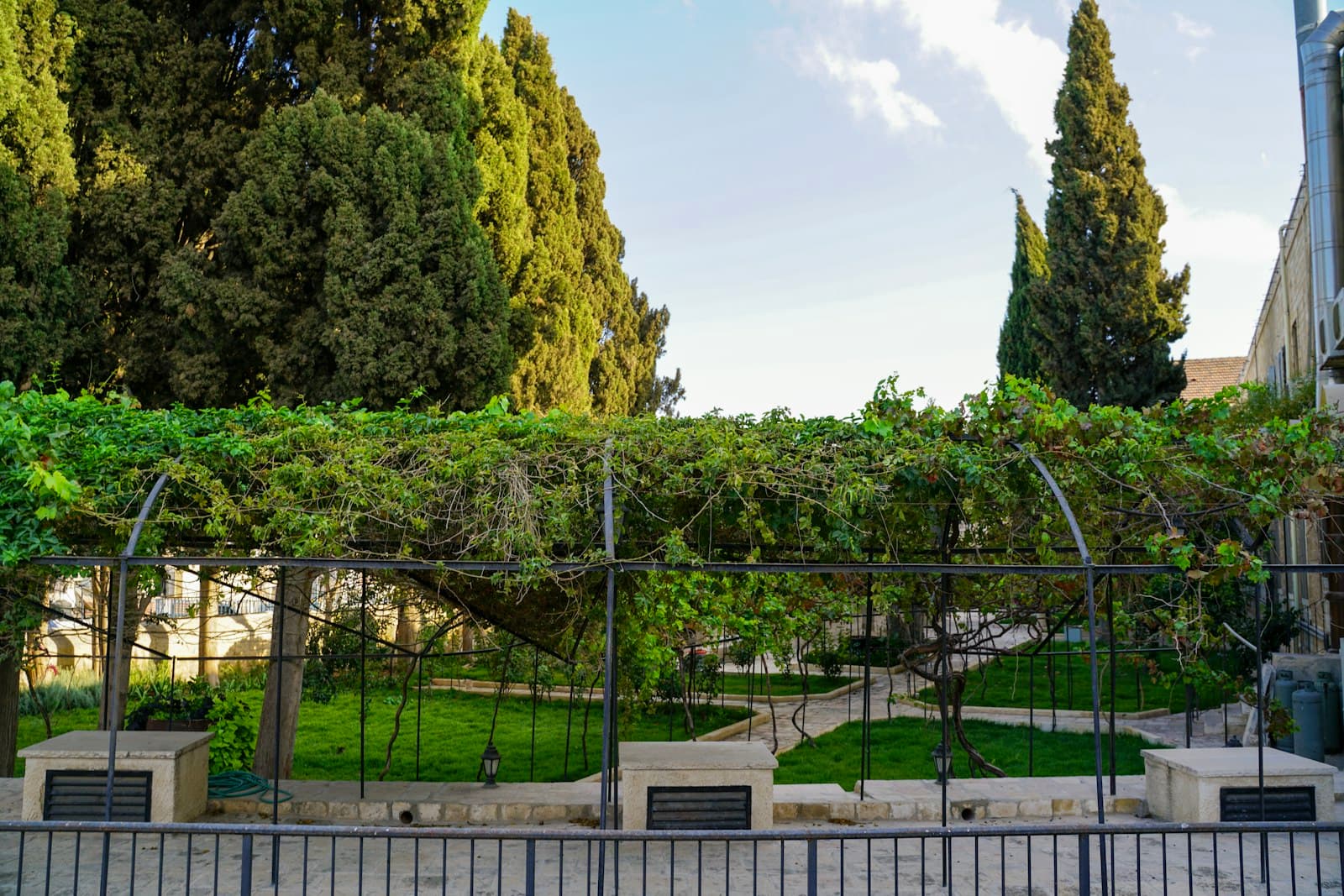
- Ensure pergola vines (wisteria, grape, climbing roses) are trained onto structure, not hanging loose to be damaged by wind.
Pest monitoring system:
- Hang yellow sticky traps in susceptible plantings (citrus, peppers, tomatoes) to monitor early aphid and thrip populations.
- Inspect olive trees specifically for early signs of peacock spot; treat preventatively if humidity has been high.
- Check for red palm weevil signs on palms (see our dedicated guide).
Vegetable garden finalisation:
- Last planting of warm-season crops (tomato, pepper, aubergine starts; direct-seeded beans, squash, cucumber).
- Mulch the vegetable garden heavily.
- Install stakes and cages before the plants need them.
Lawn transition:
- Cool-season lawn (fescue, rye): raise mowing height to 6 cm; increase watering frequency but decrease volume per session.
- Warm-season lawn (Bermuda, Zoysia): maintain 3 to 4 cm height; begin peak-season feeding schedule.
- Do not over-seed in May. Wait for September.
Final fertiliser:
- Apply a slow-release balanced fertiliser to all flowering perennials. This is the last scheduled feeding before autumn.
- No fertiliser on the lawn in Weeks 3-4 if heat is already climbing above 28 °C.
The weekly rhythm from June onwards
Once the May preparation is done, June to September settles into a weekly rhythm:
- Monday morning: irrigation check, emitter spot-check
- Wednesday: harvest vegetables, check pest traps, water container plants
- Friday: deadhead flowers, tie in climbers, spot-weed
- Sunday: full walk of the garden with coffee and the notebook — if anything is wrong, it is caught on Sunday
On villa commissions where we run the maintenance, this schedule runs automatically. On self-managed gardens, the discipline is harder to keep — but the same 20 minutes three times a week preserves everything that the May preparation achieved.
What happens if you skip May prep
In our experience across Türkiye and the Gulf:
- Unmulched beds: lose 40 to 60 percent more water, require 2x the irrigation volume
- Untested irrigation: expect at least one zone to fail mid-July, usually discovered by a dying tree
- Unpruned hedges: enter summer overcrowded, drop interior leaves by August, look sparse by September
- Unstaked climbers and tomatoes: broken by the first thunderstorm
- Unmonitored pests: early infestation invisible in May becomes severe by July
A week in May saves an emergency in August. The garden rewards the attention.
When to call us
If you have inherited a garden that is clearly not ready for summer, or if you want a pre-summer audit done by a professional, NAS runs a specific May readiness inspection on our maintenance contracts. We walk the site, write a report with photographs, execute urgent interventions, and set the garden up for a calm summer.
Send us the property details on WhatsApp +90 535 422 5227. A real landscape architect will review the site and propose a readiness plan the same working day. No charge for the first read.
NAS Landscape runs seasonal readiness protocols on villa gardens, estates, and public realm projects across Türkiye, the Gulf, and the Levant. Established 1965, Damascus. Written by MHD ZUHIR MADAMANI, Istanbul.
◆ A real diagnosis, not a guess
Send a photo. Get a plan.
Our specialists handle cases like yours across Istanbul and the wider region. Share a photo on WhatsApp or book a free site visit — whichever is faster for you.
60+ years · 7 countries · 500+ projects · third-generation atelier
◆ More field notes
 Seasonal
Frost Protection for Villa Gardens: The Playbook We Follow Every February
One night at minus three in February can undo a year of careful villa garden work. The six-step protocol we run every winter — forecast, prepare, cover, survive, recover — with the exact materials and timing.
 Seasonal
When to Plant in Istanbul: A Seasonal Guide
Istanbul sits where the Black Sea, the Marmara, and the Balkan air all bargain over the weather. A practical month-by-month planting calendar from an atelier that has worked the city's gardens since 2000.
 Seasonal
What to Plant in April in Istanbul: A Week-by-Week Atelier Guide
April in Istanbul is the most productive planting window of the year. Miss it by a week and you are planting into summer stress. Here is the week-by-week calendar we keep on the nursery wall.
Editorial & digital direction
Written, designed, and built by MHD ZUHIR MADAMANI · Istanbul